International Organisations
Authoritative global guidance, policy frameworks, development programmes and international data.
Carefully selected websites, organisations, publications and educational resources worth exploring.
This is a curated gateway to trustworthy sources that can deepen understanding of water security, sanitation, public health, ecological design, humanitarian action and environmental stewardship.
The aim is not to list everything. It is to help visitors find resources genuinely worth their time.
Each recommendation is intended to answer three questions: who is behind the resource, why it matters, and what a visitor is likely to find there.
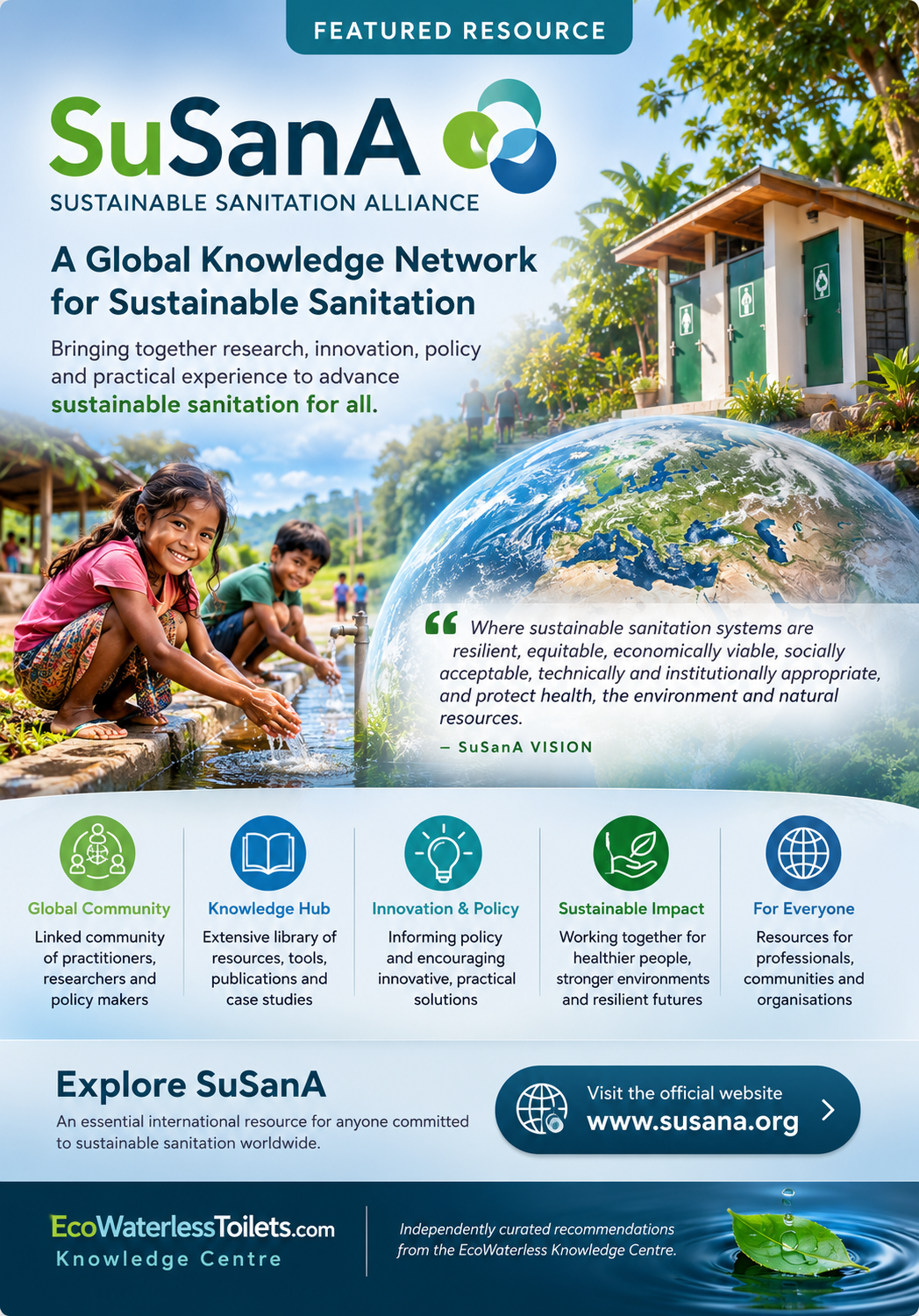
The Sustainable Sanitation Alliance, widely known as SuSanA, is an international community of practice dedicated to advancing sustainable sanitation for all.
Its vision is of sanitation systems that are resilient, equitable, economically viable, socially acceptable, technically and institutionally appropriate, and protective of human health, the environment and natural resources.
We recommend SuSanA because it brings together on-the-ground experience, research, policy, technical knowledge and an engaged international professional community.
Featured editorially by the EcoWaterless Knowledge Centre. No partnership or endorsement is implied.
The categories below help visitors move quickly towards the kinds of knowledge, tools and organisations most relevant to their interests.
Authoritative global guidance, policy frameworks, development programmes and international data.
Institutions and networks focused on water security, management, access and stewardship.
Resources exploring sustainable sanitation, nutrient recovery and circular systems.
Scientific institutes, university centres, evidence reviews and technical research.
Public agencies, regulations, technical guidance and standards-related resources.
Water, sanitation and hygiene resources for communities, development and emergency settings.
Design, installation, system selection, infrastructure and professional guidance.
Documentaries, talks, short courses, lectures and other accessible educational material.
Datasets, visual tools, mapping platforms, journals and specialist publications.
The entries below establish the permanent editorial format. They can be expanded progressively as links are checked and stronger resources are identified.
Global public-health guidance and evidence relating to sanitation, hygiene and safe service delivery.
Programmes, reports and educational resources focused on WASH in communities and schools.
A useful starting point for global water reports, international initiatives and coordinated United Nations activity.
A professional network connecting water research, engineering, utilities, innovation and practice.
Resources supporting integrated water resources management, policy development and collaborative planning.
A broad knowledge-sharing platform connecting sustainable sanitation research, discussion and field practice.
Practical programmes and public resources relating to clean water, sanitation, hygiene and long-term community change.
Research exploring water, agriculture, climate, groundwater and sustainable resource management.
Research connecting environmental change, sustainable development, sanitation and policy.
Technical and regulatory material relating to wastewater, onsite systems, public health and environmental protection.
A future collection of particularly clear and useful talks about water, sanitation, climate and systems change.
A future collection of dependable visual tools, datasets, groundwater maps, climate information and research journals.
The page should remain selective. A resource belongs here only when it offers clear value, credible information, practical tools, educational depth or a meaningful pathway into the wider field.
Inclusion does not necessarily imply endorsement, partnership or commercial affiliation. Where a relationship does exist, it should be stated clearly.
The collection can grow without becoming cluttered by applying a few clear principles.
Resources should come from organisations or authors with genuine expertise and transparent purpose.
Every inclusion should contribute directly to understanding water, sanitation, health or sustainability.
Links and descriptions should be reviewed periodically so outdated resources do not accumulate.
Visitors should understand why a resource is recommended before they leave the site.